
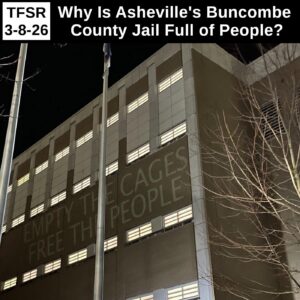
This week, we’re sharing an interview with Julie and Jeremy, two anarchists and participants in the Asheville Community Bail Fund. We speak about the US system of pre-trial incarceration aka bail and bond, the work of the bail fund locally, the overcrowding of the Buncombe County Jail here in Asheville, the ICE holds happening in the local jail, and how local policy choices regarding criminalization are being compounded by recent and new North Carolina legislation. Even if you aren’t in Asheville or North Carolina, it’s likely that much of this conversation will be pertinent to goings-ons in your neck of the woods (though hopefully not).
If you’re a regular listener to The Final Straw Radio, have a passion for enriching the anarchist media environment, feel like your values align with what you’ve heard on the show and want a chance to help out and hone your skills, we’re always looking for help. If you’ve thought of getting a podcast or other media project going but aren’t sure how to start, we can be a good jumping off point. Feel free to reach out via our emails
Links
- https://avlcommunitybail.carrd.co/
- https://www.patreon.com/Ashevillecommunitybailfund
- National Bail Fund Network: https://www.communityjusticeexchange.org
- Immigration Resources info: https://www.communityjusticeexchange.org/es/directorio-para-inmigracion
- Emancipate NC: https://emancipatenc.org/
- Lecture on Crime Data: https://www.haymarketbooks.org/blogs/338-counting-crime-a-lecture-on-the-politics-of-crime-data-and-its-uses
- NC Coalition for Alternatives to the Death Penalty: https://nccadp.org/
- Prairieland Case: https://prairielanddefendants.com/trial-support/
North Carolina Laws discussed
- NC SB-153 – Border Protection Act (pending): https://www.acluofnorthcarolina.org/legislation/sb-153-border-protection-act-anti-immigrant/
- NC HB-10: https://www.ncjustice.org/nc-justice-center-statement-on-house-bill-10-veto-override/
- NC HB-318: https://www.carolinajournal.com/nc-senate-passes-criminal-alien-enforcement-act/
Iryna’s Law (HB-307)
- https://southerncoalition.org/justice-system-reform/reframing-public-safety/public-safety-solutions-we-deserve-better-than-this/
- https://lincnc.org/when-tragedy-becomes-a-banner-reflections-on-irynas-law-and-the-politics-of-grief/
Related Past interviews
- The Prairieland Case: https://thefinalstrawradio.noblogs.org/post/category/prairieland-case/
- NSPM-7 conversation: https://thefinalstrawradio.noblogs.org/post/2025/09/28/the-implications-of-trumps-war-on-antifa-with-moira-meltzer-cohen/
Asheville politics and police repression
- https://thefinalstrawradio.noblogs.org/post/2024/05/09/clean-for-who-safe-for-who-asheville-business-improvement-district/
- https://thefinalstrawradio.noblogs.org/post/2023/03/19/felony-littering-trials-under-way-in-asheville/
- https://thefinalstrawradio.noblogs.org/post/2021/08/01/ashevilles-policing-crisis-with-ursula-wren-of-asheville-free-press/
Public surveillance by ALPR systems like Flock
- https://thefinalstrawradio.noblogs.org/post/2025/04/13/pushing-back-on-flock-cameras-with-kate-bertash/
- https://thefinalstrawradio.noblogs.org/post/2025/11/02/southerners-against-surveillance-systems-infrastructure-with-ed/
. … . ..
Featured Track:
- TFSR by The Willows Whisper
. … . ..
Transcription
Julie: I’m Julie. I use she or they pronouns. I’ve worked with the bail fund for five years, and I’ve been in the Asheville area for about 15 years, which I like to share when we’re talking about things like local carceral trends and infrastructure. Because, I think, just like anything else in city governance, it’s helpful to kind of have some historical context and an understanding of who’s speaking about an issue, how long they’ve been in that place, and what they’ve seen over time.
Jeremy: I’m Jeremy, and I work with the Asheville community bail fund as well. The Asheville community bail fund was started in the aftermath of the George Floyd uprising in 2020 when a lot of people who were involved in protesting were getting repressed. There was a lot of people mobilized to provide support for people who were getting arrested. Then after that kind of subsided, we wanted to spin off that effort into a community bail fund that could provide support to the general community and not just to activists. So we just started collecting money and soliciting people who needed to get bailed out of jail.
For anybody who doesn’t understand what cash bail is, I want to explain that just a little. Because I think most people actually don’t know that when police arrest you, you’re being accused of a crime, and then you are held in jail pre-trial. There are pretrial release conditions for you to get released before your court date, but oftentimes people — especially poor and unhoused people, marginalized people, or people facing certain charges — are not able to raise the funds to pay the ransom payment that’s required to get them out of jail before their trial.
People who are held in jail before their trial have much worse outcomes in their trial, generally. Over 95% of cases are disposed via plea deals, or plea bargaining, which means that somebody is agreeing to plead guilty to a crime that they may or may not have committed, just to get the ball rolling. We have people that have been held in our local jail for months, for years, without a trial. Part of the reason that so many cases are disposed via plea bargaining is because once you’ve been held in jail for such a long period of time you might be able to just plead guilty to the crime that you’re accused of and then get time served for that. So the bail fund exists to help try to push back against this predatory usage of pretrial detention in the criminal system.
Julie: Yes. Just to add to that, we are able to post bond for people, as Jeremy was saying, who don’t have economic means to do so. The other option that is offered to people is the for-profit, exploitative bail bonds industry. That’s what most people think about as how cash bail gets paid — through essentially hiring a service. That service is simply that you pay a smaller amount to an exploitative bail bondsman who keeps that fee for themselves and then basically is responsible for ensuring you show up at court. The cash bail bonds industry is almost unique to this country. The only other country that permits this exploitative industry is, I believe, the Philippines. So it’s not a common system, but it is, I would say, very American in its ability to create an industry off of people’s misery. So again, the role of community bail fund plays is to reject that logic of turning people’s misery into profit, leveraging the financial solidarity of community to do that. Because we’re raising our funds largely just through donations from community members and fundraisers. So really, it’s a grassroots attempt to leverage the resources of the community to support the community. We do see it as a form of mutual aid.
TFSR: I’ve got a couple of immediate follow ups if y’all are good with that. Yeah, so that that raises a bunch of questions. Some listeners might be familiar with some of these questions or topics, and some of them might not.
The Eighth Amendment of the Bill of Rights offers a protection from cruel and unusual punishment, and — I’m assuming none of us in this room are lawyers, just to get that out of the way — but it seems, like, punitive. It seems like a punishment to have someone stay in place, stay in a jail cell until they decide to give up a plea or pay money. The amount of money that the bond is related to, I imagine, relates to some kind of standardized amount of money that’s decided by some official for what the crime is? And not necessarily reflective of the ability of the person to pay it. So, for a rich person who’s carrying one of these charges, it seems like they could get out of it pretty easily, which doesn’t seem very fair from a justice point of view. But, I mean, there’s a lot to go into there. I’m wondering what are the motivations for the courts and police to get these plea deals? What precedent is there for deciding what amount of bond is assigned to a person? And, is what you’re describing what’s happening in Buncombe County in North Carolina? I imagine this isn’t like exactly the same everywhere in the US, right?
Julie: I imagine there’s gradations to it. And yes, we are not lawyers, and there may be people who can answer this more precisely who have more of a legal background. There are several questions you’ve asked, so I’ll just kind of try to address some of them.
I think overall, although there is probably differences between different jurisdictions, this is a fundamentally American criminal justice system problem. The fact of plea bargaining being not just a way, but truly the way that cases are disposed, cuts across the entire American justice system — or injustice system, as we may characterize it more accurately. I would say (without having a bunch of statistics to offer) it’s across the board, Do you want to say anything about the amendments? The Eighth and the Fifth and all that.
Jeremy: Yeah. I think that people should understand that there’s this idea that we are entitled to a right to a fair and speedy trial by a jury of our peers… That we are not supposed to have excessive bail, excessive fines, or cruel and unusual punishment, all of these things… That we’re supposed to have a right to legal counsel when we’re accused of a crime. We don’t really have any of these rights, effectively, in this system. We have a two-tiered justice system that the wealthy are able to use to do what they will with and where anybody who’s not wealthy is effectively denied their rights, unless they can mount the resources to wage a really, really long fight to try to advocate for themselves, which most people just cannot do. So pretrial detention is used as a punishment. Police and the court system know that they are using it as a punishment for people that they want to target before they’re ever convicted of any crime. So part of the motivation — and I’m going to get a little bit in to more of the motivations later — but part of the motivation for resolving or disposing cases via plea deals is because our court system literally could not handle all of the people that we’re criminalizing if we were to get the rights to a trial that we’re supposedly entitled to. The court system just wouldn’t be able to handle the sheer volume of cases. Just to your point about wealthy people being able to pay this, we had an example of this. Maybe I’ll try to go into it very briefly. There was somebody a few years ago who was a wealthy person — I believe they were a former cop — who had a millions of dollar bond condition that he was able to meet. He got out, and he murdered somebody.
Julie: Three people.
Jeremy: Three people, he murdered three people. And there was a big moral panic about this particular case, because everybody was asking, “Why was this person let out of jail pretrial?” But this person had also been waiting on a trial for years, or at least — I can’t remember, over a year. This person, if they were guilty, they should have already had a trial and been convicted of the crimes they were accused of, before they would have ever had a chance to do this. That’s an example of how this bond system lets wealthy people get away with stuff that other people wouldn’t be able to do.
Julie: Exactly. Just to use that example in counterpoint, because this was a high profile incident that, ironically, I think, has been used in the mainstream media narrative to imply that we need more and deeper penalties. Ultimately, all it does is reinforce our point, which is that cash bond does not have anything to do with public safety, right? It just has to do with the resources that people have to pay those bonds. And that those are different. Then in counterpoint to another high-profile example that was brought up in concert with this incident was almost like the exact opposite. Because the example that Jeremy just gave is the anomaly, right? Most of the people who are on cash bonds are not hyper-wealthy white ex-cops.
So, if you compare that to what is much more the normative experience, there was, very tragically, a man who killed his partner after getting out. He had been on pretrial release. His bond was still pretty high, but not nearly as high, and his partner was able to pay it. And she did, and then he got out and he killed her. The argument from tough-on-crime criminal justice advocates was that basically, he didn’t have all of his charges served on him. That actually there was a case manager that didn’t bring a court order to a magistrate…blah, blah, blah, it’s in the weeds. But basically, that if all of the charges had been served on him simultaneously, his bond would have been higher, and he wouldn’t have been able to get out, because she would have been too poor to pay it. So the message there being, if only people were just a little bit poorer, they wouldn’t be able to pay these bonds. It makes no sense.
And actually, this is a little bit of a side note, but it’s just so wild. The example of the ex-cop who killed those people, actually led to a lawsuit against the county for running a corrupt and incompetent pretrial services program, which we can talk about later. It has now been modified as a result. The main accusation, or the basis for that lawsuit, was that the reason that the pretrial services program was not able to prevent this oversight—it wasn’t able to properly manage the defendant who was out on pretrial release and prevent him from enacting further crimes—was that the pretrial services program is too focused on DEI. And [the lawsuit argued] that the funding for the program was being diverted to DEI and the program was too focused on reducing racial disparities in the jail, so it didn’t actually do what it was supposed to do, or should have done, which was prevent violent criminals from committing further crimes. It was too busy trying to address racial disparities in the jail, which is, first of all, incorrect in terms of the way that they’ve conflated these things — and I can break that down further — but also funny, because the racial disparities in the jail have been getting worse since that program came online.
TFSR: And he was a white ex-cop.
Julie: And he was a white ex-cop, right? It’s like, every aspect of it makes the least sense possible, and yet that’s that’s what we have. If you were to read The Citizen Times or listen to WLOS, that’s the narrative you’re hearing. If you don’t have the context to understand all of the like, in-the-weeds minutia of it, you’re just hearing that, and you’re believing it. That’s the narrative you’re fed.
Jeremy: To return to your question about how and who sets bond. Bond, to be clear, is not supposed to be a fine. It’s supposed to be a surety that ensures that you return to court for your court date, and then you are supposed to get that money back when you make your court date, and you forfeit it if you miss the court date. So, when you get arrested, depending on the nature of the charges and some elements of your like criminal history, a magistrate (who is a judicial official) or a judge, will review your charges. Then, based on some amount of law and policy and personal discretion on the part of the judicial official, they’ll determine what your pretrial release conditions are, which can include bond and also things like ankle monitors or other conditions.
TFSR: The bail bonds industry in the US — I’m not sure how it operates in the Philippines — a company ends up paying the full amount of the bond. You pay a portion of it, right? And then that is just given to the company in order to pay the rest of it. If you run out and if you don’t show up for court, then they end up chasing you down. Is that about how that works?
Jeremy: That’s correct. It’s 10%, so if the secured bond is set for $1,000 then you would pay a bail bondsman $100 and then they would… I don’t think they actually pay any money. They have some kind of agreement with the state, but when the case is disposed, that bail bondsman gets the full $1,000 and you don’t get anything back.
Julie: It’s also helpful to know that bail bondsman won’t work with every defendant. So, even if you want to be exploited by this system — because, hey, everyone wants to get out of jail — there are some people who don’t have this option. Oftentimes, bail bondsmen won’t work with people who have former failures to appear. So if you’ve had court matters previously and you haven’t appeared for court dates, sometimes they’ll say, “you’re just too much of a risk,” “you might not show up to court,” and they don’t want to deal with you. Very often, folks who are from out of state, they don’t want to deal with having to go across state lines to get you. And then people with like mixed immigration status, they may not want to deal with. There’s variety across different bail bondsmen, but that’s just to say that this isn’t even a system that is available to every defendant, even if they had the means to pay.
Jeremy: We have heard from some people — which seems to be borne out by what we see going on in the court system — that sometimes magistrates will set an artificially high, inflated bond payment, sort of as, like, some kind of perceived favor to the person who’s being charged with the crime. Because then it’s more likely that a bail bondsman would actually be willing to work with somebody to pay that bond payment. So, they might set a $5,000 bond when they could just set a $1,000 bond, or like, $100 bond, because a bail bondsman might not want to bother bailing somebody out for such a low bond payment. Then we’ve even seen that get reduced later, like initially set a super high bond, and then a week later it’ll get reduced, which is basically a handout to the bail bonds industry as well.
TFSR: So the bail fund: you decide who you’re going to bail out, get the money together, make the payment, and assuming that somebody shows up for court after the fact, that money comes back in and rotates back in to help someone else get out. Could you say a few words about — unless you’re planning on going into more detail about it later? Jeremy had mentioned the outcomes of people who spend their pretrial time in jail versus not. I don’t know if one of y’all want to talk about what those outcomes look like and how class features in.
Julie: Absolutely. The average pretrial stay for misdemeanors in the [Buncombe County] detention center is about 30 days, and the average stay for felonies is about 90 days. This is pre-trial, which almost certainly means that those bonds were paid or they pled out, because no one has ever disposed their felony case in 90 days, right? As we were saying earlier, these are not, “They went to trial and finished after 90 days.” So imagine, in that time period, 30 days, 90 days, what you would lose if you were just absent from your life. And there’s statistics on this. You know, even 48 or 72 hours in pretrial detention can have a significantly negative impact on your life. You’re missing days of work, you’re missing school. You have child care responsibilities, elder care responsibilities, pet responsibilities. You know, maybe you’re missing paying your rent, maybe you’re missing medical treatments. We’ve had people who were pregnant in pretrial detention, who had their next court date set so far out that they would be in a different trimester by the time they ever got into a courtroom. That’s insane. Those kinds of outcomes are immediate punishments that happen regardless of whether you ever end up pleading guilty to anything, or ever had committed any crime. That is an immediate impact of criminalization that simply has no relationship to crime, criminality, or any sense of justice. It’s just something… It’s like bad luck, right?
Then there are the differential impacts on case outcome. As we were saying earlier, when you plead out, you’re pleading guilty. So that can look different for different people, but the ramifications of pleading guilty to a crime, having that on your record are many, especially if it is a felony. You’re carrying all kinds of consequences from that for employment opportunities, educational opportunities, the list goes on. But for people who do stay inside and actually attempt to fight their case from inside, they have way worse outcomes. They get convicted much more often. They have longer sentences, even… Because think about it. Think about everything you need in order to properly defend yourself. You need to be able to be going around and talking to witnesses, gathering your own evidence, looking at your own discovery, everything that you need to do, which is a lot. Being a defendant in a case is a lot of work. It’s functionally impossible to do from behind bars. You don’t have access to your lawyer whenever you want. You don’t have access to the internet whenever you want. You can’t just call someone and be like, “Hey, what did you see?” I don’t know which one of those outcomes you were you were talking about, but all of the above.
TFSR: I think for a lot of folks that haven’t had to think about this before, thinking through the implications of the day-to-day, as you said, and all the cascading effects that being out of work or being being unable to provide care or whatever that looks like… Plus what you said, building your own defense, and, I mean keeping your property, like your house, all the stuff in it. Yeah, I think all this stuff, if you haven’t had to think about this, you haven’t had to think about this. It may be, or hopefully should be, a little bit mind blowing about, like, how devastating this is on so many different levels.
Julie: And this is such a side note, but, I mean, we think about, okay, if you’re out of work, you lose your job, or at least, you lose income during the period that you’re gone, which is bad. But we’ve actually had, on the flip side, employers calling us, being like, “Hey, can you get our employee out of jail? We need them at work.” Like this is impacting a whole ecosystem of people. This is leaving a hole in a community, and it is deeply felt on both sides. So you know, that’s probably less the thing that people focus on, understandably, but yeah, we’re all connected.
TFSR: And again, to restate, this is pre-trial. This before someone’s been duly convicted of a crime or pled out to it, or whatever.
After 2020, a narrative spread across the US, particularly in right wing media, about the crime levels in Asheville specifically. This is kind of crazy. I remember staying at a hotel and seeing, like, One American News or something like that was on the TV, and I was flicking through. It was like, “Asheville!” and images of flames, and I’m like, what the hell’s going on? This narrative was all over the place, and I wonder if you have any knowledge of what has become of the smoldering ruins of the city of Asheville? And how does this narrative that was coming up relate to the state of the police at the time — their high attrition rate, the money that the police were spending on a PR firm and grassroots groups, like the Asheville Public Safety Coalition.
Jeremy: Yeah, I love talking about this, because it’s so ridiculous. After the George Floyd uprising in 2020 and with COVID and everything that was going on with that, there was a campaign to defund police departments all over the United States, which was largely unsuccessful. The police were not defunded in Asheville or in Buncombe County. In fact, their funding only increased, but there was a recruitment problem. The police department was seen as understaffed and had an unusually high amount of vacancies, which resulted in them getting more money. But nationwide, there was a “crime wave” narrative that spread around the media, and part of what contributed to this situation, particularly in Asheville, is the FBI annual crime report, which I think is a really interesting, weird report. They publish this report annually, and if you go read the report, it says in the report that the report is not useful for measuring year-to-year trends in crime. For their 2020 report, they also specifically changed some of the criteria that they were using to measure what they were considering as violent versus non-violent crime. If anybody is interested in learning more about this, there’s a great talk from Haymarket Books that you can find on YouTube that’s titled “Counting Crime: A Lecture on the Politics of Crime Data and Its Uses” by Tamara K. Nopper that I recommend.
In 2020 when the crime report came out, a bunch of right-wing media seized upon it, and this crime report uses data that’s voluntarily reported by individual police departments. So this FBI crime report doesn’t include any data from notoriously high-crime cities such as New York City, Chicago or Los Angeles. And this [report] was used by some malicious media. There was an article — I think the outlet was called 24/7 Wall St. — that published an article that listed Asheville as one of the top 10% of highest crime cities in the United States. Which, for anybody that is familiar with Asheville or crime in this country, that’s an absolutely ridiculous claim, and it’s like pretty funny. But this claim was reproduced in local news media. WLOS quickly ran a story reproducing this, talking about how Asheville was in the top 10% of crime in the country. Then in a series of other articles about crime in Asheville around the time, the police would reproduce that narrative by citing that story, and, you know, they would interview police in articles, and police would be like, “Yeah, Asheville is one of the top 10 highest crime cities in the country.”
As far as I saw during that time period, none of the local media was doing any fact checking or any critical analysis of this claim, which is egregious. This claim also was seized upon by certain local business interests and the wealthy who wanted to advocate for more resources to the police and for crackdowns on the unhoused population. That was the big thing that motivated the Asheville Public Safety Coalition, which formed at the time. Basically, this was a collection of wealthy people and certain business owners — not all business owners, because a lot of local business owners recognize this group as as kind of a wingnut, fascist organization. But, they would say things in meetings like, “I shouldn’t have to see an unhoused person,” or “I shouldn’t have to interact with an unhoused person. The police should be cracking down on these people and getting them out of here.” And in a meeting with the DA, the DA was hearing their complaints about panhandlers and unhoused people downtown, and alluded to a law that was in the works that was called the Pretrial Integrity Act, that would make it harder for people to get out of jail, basically. He alluded that, when this law passes, we’ll be able to use this to round up unhoused people and keep them in jail for longer, to appease this group. So that’s where the moral panic came from. It was really manufactured and does have very negative consequences.
TFSR: And it’s making this comparison between somebody who’s asking for help and maybe not promoting your business interest with criminality somehow.
Julie: And I want to, like, name that it’s easy to kind of overcorrect and fall into this narrative of like, “Oh, of course it’s ridiculous to say that there’s violent crime in Asheville. It’s this idyllic tourist town.” There is violent crime here, and by that, I want to re-frame that as people do harm to each other here. There is gun violence here, and I don’t want to like, dismiss or belittle the reality that communities are experiencing harm and the impacts of that harm. But we know that the responses to that — both to intensify criminalization, to intensify the severity of legal consequences, and certainly the narratives that you know kind of flatten all of this and vilify people — do not help that underlying reality. There, I think, are probably people with good intentions who want to see those social issues addressed and want to see the harm reduced. And they’re not being given options that would authentically address those problems. They’re only being given this crime wave hysteria narrative that that ultimately only achieves the opposite.
I also would add in addition to the misuse or misapplication or misinterpretation of federal crime data, I think you also have to look at what was happening after 2020. Yes, there was a desire to kind of reinforce the importance and legitimacy of law enforcement. There was an unprecedented willingness to critique law enforcement. But then that wave rolled back, and there was a backlash, and there was a desire, once again, to uphold the need for this violent presence in our society. That was part of that narrative.
But also economically, people were trying to come back from COVID, right? Businesses were trying to come back from COVID. And the last thing that anybody wanted was any threatening to the sanitation of central business districts. There was a need to have commercial corridors feel as nonthreatening to capital and to tourism as possible. I personally think that that’s one of the reasons that we see at that time that desire among business interests to really try to, you know, so called “clean up the streets.” Which I always remind people, when people talk about cleaning up the streets, they’re talking about putting people in a trash can called a jail. When you hear “clean up the streets” or “doing sweeps.” You’re talking about sweeping people into cages.
TFSR: So part of why we’re here is to talk about the status of the Buncombe County Detention Facility, the jail in Asheville. Could you tell us a bit about the jail, its capacity, who’s being held there, and what part of the legal process that many of them are in?
Julie: There was a desire on the part of some people to build a new jail back around 2016 but fortunately, that didn’t happen. But it’s a fairly modern facility as jails go. So super quick: jail versus prison, just to set that terminology — a jail or detention center is run by a county sheriff’s office, and it is where people are taken pre-trial, and sometimes serve shorter amounts of sentences, up to, I think, a year. Prison is where you are sent if you are convicted in a state or federal jurisdiction. Just to get a sense of what a jail is. And so, because of the nature of what a jail is, it is typically largely pretrial — as we’ve been talking about — [regarding] detention population; people who have not been convicted of a crime yet.
But there is some wiggle room there. There are other types of prisoners in jails. One category is federally-housed inmates. So when there’s overcrowding in the federal prison population, they will actually offer money to counties to house federal prisoners. And so in Buncombe County, the official jail capacity of the whole jail is 524 people. But that’s all told, so that includes differences between different sides or parts of the jail, right? For instance, they have the so-called men’s and women’s side. So the capacity for the men’s side is higher than the capacity for the women’s side because they anticipate more people who they think are men being incarcerated, right? So if you look at the population of the jail, and it says 500 — because you can go online and see a jail roster — you might think, “Okay, we’re under capacity. That’s good.” Not really. When you see that number hit 500, not only are you getting close to total capacity, but if you actually disaggregate that by different types of prisoners, you are more than likely already seeing overcrowding, doubling up, and the bad conditions that result from that. We are seeing that now. We’ll talk more about that later.
So just to say, to come back to the federally-housed versus pretrial. The vast majority of our jail population is in pretrial detention, which, again, is common, but the level has changed over time. It’s very important to look at that, because in 2017 the jail population had been rising, and the narrative was that, you know, we might need to build a new jail. Fortunately, there was not enough political will for that at the time, and people actually wanted to try to see what we could do to reduce the jail population. But at that time, in 2017, the share of the jail population that was pretrial…So of the people in the jail at that time there was about 500, which was again hitting capacity, and that’s why they were talking about building another one, potentially. When it was spiked up that high, 65% of those people were pretrial. The rest were federally-housed inmates, people serving short sentences. In 2024, it was 86%. So between 2017 and basically now, or in the last couple of years, the share of the jail population that is in pretrial detention went up by 20%. That matters a lot, because the number of federally-housed inmates is really up to the jail administration. They can decide whether or not to take on those prisoners based on their capacity, based on whether they want the money. So now that kind of flexibility is gone. 85-90% of the people in the Buncombe County Detention Center are now pre-trial, which means that they don’t really have the ability to modulate their own overcrowding, Or said another way, the people that they’re housing, they have to be housed there. Which is, again, a recipe for overcrowding, which is what we’re in. I guess I can also speak about the racial disparities in the jail.
TFSR: Also, [from] that presentation that you gave at Firestorm not that long ago… In reference to the the swelling of the population — seeing an email from the sheriff to other sheriff’s departments in the area asking for help in housing the already-overcrowding population is pretty incredible. But yeah, just to touch on that, and if you want to reflect on that, that’s great. But also, if you want to talk about the racial disparities and the changes in that, that would be important.
Julie: I will say, the racial disparities. We live in a white supremacist society. Our criminal justice system is just thoroughly racialized and racist from bottom up, top down. So that’s nothing different in Buncombe County. We have about 6% of our population in the county is black, and historically, about 25% of our detention population has been black. So, obviously, you see a huge disparity. And actually that disparity for black Americans has been getting worse over time in Buncombe County. I know maybe we’ll talk a little bit about that later, but just to say that, when we think about who’s in the jail, you know, overwhelmingly, it’s poor people and unhoused people very disproportionately. It is people of color. That almost feels so obvious, but it has to be said. I mean, for people who pay attention to criminal justice issues, we know that racial disparities are just deeply part of the system, but it certainly bears saying that that is the case here.
TFSR: And to restate, also, a great majority pre-trial — not having been convicted of a thing, right?
Julie: That is a function of many factors. I mean, obviously the criminalization of people of color is more intense. But also, again, this tracks with with class, right? More people are unable to get out of pretrial detention if they have less access to financial wealth. Again, going back to our juxtaposing the rich white ex-cop and the black man who… This guy [the ex-cop] was able to pay $1.6 million bail by putting up his eight properties that he owned, you know, as collateral, versus this woman who was, you know, living in public housing and was not able to pay.
TFSR: Yeah, so I remember in 2020 there was a call from a bunch of community organizations and individuals in the community for decarceration. And for a change in the way that people were being held, because the jail was housing people during a pandemic and during the height of a pandemic, especially when we weren’t quite understanding about how the disease was spread. The facility is not set up to be able to safely house people. For these reasons and more, the county and the sheriff’s department that runs the jail, as well as patrols and the police department (and I’m sure the city manager,) ended up changing the way that people interfaced with the jail. The population inside of the jail of people facing pretrial detention decreased. There were changes in citation versus arrest that occurred. There was this big decrease in the amount of people being held in the jail, which kind of, occurred to some of us, like, “Huh? I wonder, why can they do this now and still say that they’ve got a functioning justice system? They can choose to decrease the amount of people that are in the jail at any time.”
But anyway, like authorities said at the time that they were still housing people that were they were considering to be a public danger, or danger to other people around them. This is a lot of the heavy lifting in what I’m saying right now is a presumption that we can trust what public officials and police are saying about what they’re doing and why. But the population has jumped up since 2020 inside of the jail. And I’m wondering has there been a big increase in violent crime? Is this reflective of the misreading of those FBI statistics?
Julie: Yeah, absolutely. And thank you for honing in on this, because there is so much here. So, as you mentioned, the only time really that we have seen a significant drop in the detention center population, at least since, let’s say, the last decade — you know, I mentioned that in 2017 it was high, people were talking about whether we needed a new jail — the only time between then and now that the population of the detention center has gone down appreciably was during COVID, for the reasons you mentioned. That being said, it wasn’t just… Well, it was just because of COVID that the population went down, but there was actually a pre-existing effort and narrative about the need to decarcerate the jail. They were able to actually, I think, disingenuously fit that dip in 2020 into [it] because what they started in 2018… I’m going to talk about something called the Safety and Justice challenge, which is a grant program nationally through a partnership of the MacArthur Foundation, the Vera Justice Institute, maybe some other nonprofit foundation players… But basically, this attempt to throw money at the constant problem of jail overcrowding and racial disparities. Starting in 2018, when the county started securing funding from this program, and the goals of that program were to reduce the jail population and reduce the racial disparities in the jail. There were a couple other ancillary goals, but those were really the two main main metrics. They did not make any progress, right? They started in 2018. They did not make any progress until 2020 because of all the reasons that we’ve just been talking about, right? The narratives about crime and wanting to crack down and all this.
Then 2020 hits, and the measures that were taken to mitigate the crisis because of the virus were taken, like you said. Showing that it’s possible to take truly decarcerative measures. Not abolitionist measures — there were still tons of people in jail — but, you know, to reduce the population. It was at that point that all these articles started rolling out. Suddenly, everyone was talking about the “Safety and Justice Challenge,” and how Buncombe County was in this program, and they were making such strides, and look at our numbers. Well, it turned out that the exception proved the rule, and as soon as that wave rolled back, we started to see the jail population start to go back up again because of this crime wave hysteria that really intensified. You know, it’s always there. There’s always a desire to just vilify people who are down on their luck. But it really took off, as we’ve been talking about, after 2020. So, not surprisingly, the numbers started going up, and it didn’t matter that they were getting millions of dollars.
Since when we started in the jail, there was about, I think it was the population was stabilizing around 480-490 at the time. At this point now, we’ve gone for eight years and we’ve gotten $5 million, and today, the population of the jail is higher. It is — depending on what day you check — between 18% and 21% higher today than when we started this program. The racial disparities are worse. When I talked about the racial disparities earlier, I said that we had 25% black [people] in the detention center. Now it’s actually more like 31%. You know, that’s what eight years and $5 million gets you in Buncombe County. When you’re supposedly focusing so hard on addressing these issues, you end up with worse outcomes. I think that says everything you need to know. It’s a self-indictment. That is, you can’t characterize that as anything other than an abject failure.
I would argue that you can’t characterize the reason for that failure as anything other than, if not intentional then just neutral. They spent the time, they got the money, and they were not ever really committed to it, because the crime wave hysteria narrative always won out. And so to your question, no, this has nothing to do with crime levels. They don’t explain the changes in the jail composition or size. But what does explain it is, again, that crime wave hysteria narrative, legal changes that have led to more draconian laws that cause people to not be able to get out of pretrial detention, and enforcement priorities. They shifted marginally during COVID and then they shifted back, and they’ve never gone down since then. In moments when the narratives we’ve discussed are really being pushed out, we see that increase in scooping up vulnerable people.
In 2023, when I think you can kind of argue this crime wave hysteria narrative really, like reached its height, property crime was actually down 32%. It didn’t matter. It didn’t matter! The reality didn’t matter. The central business districts were trying to bounce back from COVID, and they needed to sanitize that commercial space for tourism. So that is what we saw. We see tons of unhoused people, or kind of semi-housed people coming through the system. I believe that we’re also seeing this crest a little bit again after Helene. It’s a little bit different. We know we already had a housing crisis, and obviously Helene made it so much worse. I forget the statistics, but, something like 400,000 units of housing stock were damaged or destroyed. Obviously, there was also high unemployment last year. Everyone was set back individually. The town was set back. So again, you’re seeing that this is just going to lead to warehousing people, because we have a system that encourages that process of deciding that the way that we bounce back from these crises is to get a certain type of people, who are seen as disposable, out of view.
Jeremy: On the point of Helene, I think it is worth noting that Helene was a time when there was kind of like a temporary leveling. Everybody was kind of the same, in a way that is unusual. You could go and walk down the street. If you are in the in the urban area, you can go walk down the street. You could go find food. There were unhoused people and housed people hanging out together. It was very unusual. And then when infrastructure was somewhat restored, we started hearing messaging from public officials that the unhoused people downtown have become too comfortable. They’ve become too used to being able to exist into public space, and that we have to roll that back, and that’s what they did.
Julie: I personally heard that narrative being stated explicitly, certainly behind closed doors and maybe also publicly.
TFSR: I think that it’s important that people consider functions of the state that have budgets and that have workers, such as police and jails as being machines that have an interest in self-sustaining; that have an interest in increasing their budgets; that have a vision of, as businesses, how they continue to make themselves profit making and getting funding and continuing to employ people through their their own self interests. Even if there’s a decrease in measured crime in an area, like harm between people, it makes sense in this culture that these institutions would attempt to… They’d still be on the path to make themselves look necessary, not diminish that. So even if there’s less crime, they’re going to have more arrests, because they’ll find other things to pull people in for. Because those beds in the jail are already built, the staff needs to have a reason to go to work in the morning.
Julie: Yeah. Everything you’re saying is true. It’s really sad, because, I mean, even… Like, it was already a messed up system, but you want to believe or think that especially in the wake of crises that are so deep and so broad that they’re literally world changing — like COVID and Helene, that remake people’s daily lives for a significant period of time — that at least in those situations, people would be like, “Oh, maybe people are struggling really badly right now.” That there would be some grace, that there would be some… I don’t know, just centering of the humanity of people, at least for like, a little time. I think that’s like a takeaway, that the poly-crisis is not only real, but it will always continue to feed into our pre-existing systems and exacerbate them and make them worse — Helene even more so than than COVID. I mean, it’s unconscionable that people can be clamoring for cleaning up the streets when you know who’s on the streets! Like you know why people can’t find a home. You know why people are struggling. We’ve all just been through this thing together, and I don’t know. It’s just… It’s really sad.
Jeremy: Yeah, and when you think of government agencies as organizations that have an interest in self-sustaining and increasing their budget perpetually, that’s one of the reasons I think it’s so important to prevent them from building a new jail. Because if they build a new jail, they will fill those jails. That is just… You know that will happen.
TFSR: Getting back to the sheriff’s department and the jail. For most of the last couple of decades, the sheriff’s department in Buncombe County, who run the jail, have publicly said — like the sheriffs, at least, who have been elected — have said that that they wouldn’t actively cooperate with federal immigration policing. What has changed with normally mundane interactions with law enforcement escalating into ICE holds in Buncombe County? What changes are we seeing in people’s access to bail who do get put on an ICE-related hold? Is this a preemptive compliance or is it legally mandated? Because I know that your presentation talked about a few state house and senate bills that have come up relating to pretrial incarceration, right? Or to collaborating with federal immigration authorities.
Julie: All the above. They’re all just tangled up together, all these massive bills.
Jeremy: Yeah, so I think that it’s important to be specific with what the county’s messaging has been about their cooperation with ICE. Because there’s this notion floating around that has been reproduced by the current presidential administration that, like, Asheville is a sanctuary city or something. Which is nonsense, unfortunately. But what the county has not done, to their credit, is the sheriff’s office has not entered into a 287(g) agreement with ICE. This is an agreement that has existed for a while. What it basically does, is it deputizes local police to act as ICE agents and to serve ICE warrants on people. Our sheriff’s office has not entered into that. Other county sheriffs’ offices around the area have, at some points, entered into 287(g) agreements, and at other points have not. Because it’s an unfunded agreement that is just… Really, I think it’s like red meat for a reactionary constituency who is excited about having their local police arrest immigrants. And we don’t have that here, fortunately. However, also what they have said is that they are going to abide by the law, which has changed in North Carolina recently with some of the bills that we can go into more specifics about later.
Last year there were some bills which were passed in North Carolina that require the sheriff’s office to honor ICE detainers. What that means is, when somebody is arrested, the sheriff’s office is making a determination about whether or not the person that is being booked into the jail is a citizen. If they are not, then they report them to ICE, and then ICE can issue an administrative warrant, which will cause the person to get an ICE hold. What it means when somebody gets an ICE hold is that the county has to hold them in jail at the point in time at which that person would be released. Maybe their case is dismissed, or maybe their case is resolved and they are found innocent or guilty.
Julie: Or they pay bond.
Jeremy: Or they pay bond, or they go to prison and serve out their sentence. At the point in time they would be released, a 48-hour hold goes into effect where they are required to be held for ICE to come pick them up. So the county is sending people to ICE. They are abiding by that law, and we are sending people to ICE on a weekly basis. Oftentimes that’s people who have been arrested for minor traffic violations, maybe driving without a license or driving impaired. [They] get picked up, it triggers an ICE hold, and now they’re going to be held in jail until ICE can come pick them up. This is a state mandate. This is not preemptive compliance, and this is not them going out of their way, as far as we know, to cooperate with ICE. The variable here that we don’t really know, and I think is sort of impossible to know, other than to speculate upon, is to what extent individual police officers or other police departments outside of the county are maybe motivated to act in different ways, considering that this law is in effect, right? So the people who end up getting processed by the Buncombe County Sheriff’s Office and put into jail and reported to ICE are not necessarily arrested by the Buncombe County Sheriff’s Office. Anybody who was arrested in any of the cities in Buncombe County — be that Asheville Police Department, Black Mountain Police Department, Woodfin Police Department, and others.
We know that police arrest people oftentimes on nonsense charges because there’s no accountability for individual cops. We often hear from people that they just get picked up. You know, sometimes the cops will decide they want to detain somebody and then decide what they’re going to charge them with after the fact. So there’s really nothing stopping a racist cop from racially profiling somebody, arresting them on some bogus charge, and then, once they’ve been arrested, now they’re stuck in the system. If an ICE hold gets issued, then they’re likely to get picked up by ICE. So that is, I think, where, if the county or the city or any government body here wanted to actively resist cooperation with DHS, they could instruct their police departments to refrain from arresting people on minor charges and try to hold their cops to that. To my knowledge, they’re not doing that, but that would be a way they could legally resist that mandate.
TFSR: Has the jail been sticking to the 48-hour hold period?
Julie: As far as we can tell, yes. It’s unfortunate, but ICE does seem to be coming within that 48-hour window. Now, I can’t say… I won’t just say perfect. We don’t have good systematic data about this, but from the amount of tracking that we as the bail fund have done… And just from individuals and our relationships with organizers in the immigrant community, it does seem that they are holding to that 48 hours, simply because ICE is coming before that 48 hours elapses. Now, if they didn’t come within 48 hours, I can’t say whether they would hold them beyond that or not, but so far, it hasn’t, at least in a widespread way, been tested.
I just wanted to say a little bit, from the organizational side of the bail fund, how we have kind of been interacting with the reality of assaults on the immigrant community. First of all, there’s a lot of talk about bond funds and immigration bonds. I just want to clarify that our bail fund is totally separate from the immigration bond system. Immigration bonds are bonds that are placed on people who are in immigrant detention already. There’s two different bail fund or bond fund entities and goals. As a community bail fund, we don’t post bail in the immigration system, but we were hoping that we would be able to use our community. Knowing that people were being transferred from the detention center, here was a window of time in which we were hoping that us partnering to maybe post bail quickly for people as a tactic to avoid them getting transferred to ICE custody would be possible. Unfortunately, that was quickly foreclosed because of how HB-10 (the law) was written. Then especially after a subsequent law, HB-318, closed some loopholes. Basically, that tactical avenue was foreclosed, which was a huge disappointment for our collective because we really wanted to be able to leverage our organizational infrastructure to help out in in this particular situation.
On top of that… now moving over to the immigration bond system, once people are actually in ICE custody, we’ve also seen, unfortunately, immigration bonds be —I won’t say, totally foreclosed, but — really sidelined as a tactic that people who are interested in liberation can use. And this is like super arcane legal challenges, and everything’s changing. I don’t have all the information, and if you ask tomorrow, the answer will be different, because this is literally being worked out in courts, circuit courts and appeals courts as we’re speaking. But basically very, very few people are being offered the ability to pay bond within the immigrant detention system. That used to be a major way that people could at least get out of ICE custody, while their cases… which, oh my gosh. I mean, we’ve been talking about how long cases taken the criminal justice system. You know, put that on steroids for the asylum cases, immigration cases. I mean, they just stretch on, literally, for decades. It was just tragic to see the tactics that we’ve developed over time really be foreclosed and sidelined, and just to say that we have organizationally been able to be in deep relationship with local immigrant organizers and are in constant communication about the people that we see going into and out of the detention center, sharing information and trying to share resources to support folks, because people are being taken every week.
This is something that I want people to understand: that just because there aren’t raids on workplaces, just because they’re not outside of schools, just because it doesn’t look like what we’ve seen on TV, doesn’t mean that people aren’t being taken. They’re being taken in custodial transfers, which is when they’re taken from the detention center. It’s happening every week. I think it’s really important to recognize that like people who are loved and valued in this community, are being kidnapped every week through these custodial transfers. It doesn’t have to look like Chicago or Minneapolis for the community to be raided. Like we are being raided, but just in a slow-rolling and hidden way. I just think it’s important to understand that like homes are losing parents and co-parents and breadwinners and co-workers, and these holes in the community are being left and in some ways it feels almost harder, because it’s out of sight and out of mind for a lot of people. I think that allows them to get away with it, because people aren’t seeing it. Like so much else that happens behind the walls, the whole point is that it’s out of sight.
TFSR: Yeah, so you named HB-10 as one of the laws impacting this. HB-318, so House Bill 318 and I think Senate Bill 153? Is that like a pending one that’s potentially going to have impacts on this, or is that already passed?
Jeremy: It’s still pending. Yeah, I can talk more about the laws if you…
TFSR: Yeah, can you all talk about Iryna’s Law? Who pushed for it, and its impact? I remember that there was… I remember seeing footage of a rally by Patriot Front in North Carolina after the passage of this. What sort of impact has this law had on this little city that we’re in, for instance, and the homeless population here?
Jeremy: Last year, we saw the state of North Carolina pass a spate of tough-on-crime and anti-immigrant legislation, which we touched on a little bit already. That’s one of the reasons that the sheriff’s office now has to honor ICE detainers and transfer people to ICE. Most of this legislation was pushed for by Republicans and passed pretty much along party lines. It was almost totally Republicans voting for it and Democrats voting against it, with the exception of, there were some Democrats that needed to cross party lines to to override these. These bills were actually vetoed by the governor, and then the vetoes had to be overridden by the North Carolina House and Senate, which requires a super majority. But they were able to override those vetoes. And one of the exceptions to this is Iryna’s Law. Iryna’s law is referring to HB-307, which passed with bipartisan support, with very little pushback against it.
This bill — people probably heard, it was national news — was passed. And I don’t want to downplay this. There was a tragic, horrible murder of a Ukrainian refugee named Iryna Zarutska. And this was like a horrible crime that is also unusual, right? Like this was a terrible murder, that was seized upon cynically by the media and the right to create a renewed crime wave and a moral panic. You know, white supremacists very actively latched upon this too. People kind of martyrized Iyrna, and white supremacists were clearly celebrating this law. Like I said, it was passed with bipartisan support and not vetoed by the governor, unlike most of this other legislation. It’s probably the worst piece of legislation out of the batch that passed last year. The bill does a lot of things that are not really even related to the crime that happened. Among the things that it does is it completely removes what was called “written promise to appear” as a pretrial release condition. For most people, if you are arrested and charged with a minor crime, then you are released on your promise to appear in court on your court date, which works for most people because most people actually want to make their court date. Because if you miss a court date, a warrant is going to be issued for your arrest, and you’re going to be in a lot more trouble than you would have been otherwise, right? It removes written promise to appear. So now, at best, you are going to get unsecured bond, which means that if you miss your court date, you are going to have to pay a probably thousands of dollar bond payment on top of getting a failure to appear in court.
Additionally, it removes unsecured bond as a pretrial release condition for a variety of people — for people who are charged with crimes that fall into a category that is considered violent crime, which includes first degree trespassing, among other things, and people with certain criminal history. For anybody that has been convicted of at least three Class 1 misdemeanors in the past 10 years, unsecured bond is off the table for them. What that looks like, especially in a city with a large unhoused population, is people get picked up on minor crimes like trespassing — or other crimes, you know, possession, drug possession, paraphernalia or other things — and get held in jail, and, oftentimes, eventually plea bargain and plead guilty. These cases almost never go to trial. Then after you’ve racked up three convictions, now you’re going to be stuck in jail every time you’re arrested, unless you can pay a secured bond payment, which most people are not going to be able to pay.
TFSR: So say someone is like sleeping at the edge of someone’s property, and they get pulled into jail. They’re held pre-trial because they can’t pay whatever bail, and so they plea out, that would be an example of one of the convictions. And then they get released on time served, and then get picked up again because the police are looking out for people sleeping at the edge of properties or whatever. This could be one potential process that someone would fall into this trap?
Jeremy: Potentially, I don’t want to… I think really there’s some nuance when it comes to the laws and this is where I think… So Class 1 trespassing requires a breach of a property. That would be like somebody jumping a fence and sleeping on the other side of a fence in a property that they’re not supposed to be allowed on, or whatever. But as I stated previously, I’ve heard stories from unhoused people who have literally just been arrested walking down the sidewalk and charged with trespassing. So you know, there’s an element of, like, what these crimes… I think it kind of doesn’t matter, because, you know, people are often pleading guilty to crimes that they may have not committed. But yeah, if somebody has done that in the past, if somebody has been convicted of these crimes and pled guilty in the past, and then they get arrested for sleeping outside at the edge of somebody’s property, the fact that they have that criminal history will cause them to get hit by Iryna’s Law and not be allowed out.
Julie: In sum, this will lead — it already has led — just inevitably, to an increase in the pretrial detention population. And that’s not, like, our analysis as abolitionists or even as people who work with a bail fund. That is the analysis of the pretrial services program, who we’ve heard from; the public defender’s office, who we’ve heard from; even the candidates for DA. If you look at the recent statements that people made in the DA debate. Everyone mentioned Iryna’s Law. The sheriff has mentioned Iryna’s Law. Not just our sheriff, but all the sheriffs. You know, this is, ironically, like, seen as a crisis. Law enforcement considers this law a crisis. And that is unique. I haven’t seen that before.
Jeremy: It was shortly after this law went into effect that the jail reached capacity, and our jail had people sleeping on the floors because there weren’t enough beds. Our sheriff wrote a public letter to other counties asking for other counties to take our prisoners into their jails. So that’s the level of dysfunction that this law has created. There’s other aspects to this bill too that are really bad, like, it expands the requirements and is kind of, like, redundant to some other bills, which I’m not really clear on why that’s the case. But it requires that the judicial officials look into people’s citizenship status and make a determination for impaired driving offenses and other offenses and report them to ICE. It has other requirements that have not gone into effect yet that people are very concerned about. It’s got some, for example, new requirements around involuntary commitment that will not go into effect until December. Basically, what this is going to do is — depending on people’s charges and stuff — it’s going to create a situation where, when certain people are arrested, they are going to be required to be immediately and voluntarily committed. Then once you’ve been involuntarily committed, if you get arrested and you have previously been involuntarily committed — I forget what the time frame is, but if you’ve been previously involuntarily committed within the past year or maybe it was three years, or five, I don’t remember the time frame — then regardless of what you’ve been arrested for, you are automatically involuntarily committed again.
Julie: Which is just so bananas. I mean, from every ethical and medical healthcare standpoint. And also from a logistical standpoint. What I just said about law enforcement seeing this law as a crisis? The healthcare system… I mean, can you imagine going to the emergency department after this goes into effect? They don’t have the capacities to care for or even warehouse all of the people who will be subject to this. That is one of the reasons that those provisions aren’t supposed to go into effect until December, because the very enlightened people who passed this law were like, “Ooh, maybe we should give them a little bit of time to prepare for this.” It’s not going to be enough time. There’s no amount of time that is enough time, especially when it doesn’t come along with any kind of funding whatsoever to support it.
I think it is both true that Iryna’s Law… We can track that the implementation of this law is contributing to or even causing the overcrowding at the jail. But I think it’s important to put that in conversation with everything we’ve already talked about, right? If we didn’t already have such an addiction to incarceration, and if we hadn’t already basically decided that we were going to warehouse people in the jail, we wouldn’t have been so close to the threshold. Like we were already, before this happened, getting close to that threshold, and now this is just creating that crisis condition. But you know, if we were at the levels that we were at during COVID, there would be a lot more give in that system. So it is both true that judicial officials have their hands tied in a certain respect right now because they don’t have the discretion not to give people these cash bonds. And it is also true that we made this bed to lie in.
Jeremy: Yeah, and while it doesn’t bring back the death penalty — or it doesn’t bring back executions immediately — it also is starting to set the groundwork for that. We do have a death penalty in this state, but North Carolina hasn’t executed anybody on death row in decades. And another requirement of this bill is that by next year — or something like that, there’s some time frame — the state has to review all of our death penalty cases to assess the viability of moving forward with executions using alternative means that haven’t previously been on the table, such as electric chairs and firing squads. It doesn’t, as far as I understand — like, I’m not a lawyer and I’m not a policy writer, I don’t really fully understand these requirements or what the implications of them are — but it does seem like it’s trying to get the ball rolling on like, can we start executing people again?
Julie: People should look into it and read it. The way that people talk about, like, HR-1, right? The Big Beautiful Bill. I think Iryna’s Law is kind of the analog of that, but, like, focused on criminal justice in North Carolina. It just has so many parts to it.
Jeremy: It’s like 21 pages.
Julie: Yeah. There’s so much in it, and it’s all so bad.
TFSR: Are there any organizations like Heritage Foundation or whatever that are like behind producing and pushing this policy? And was it just responding to the general ambient churning of tough-on-crime spectacle of “increased dangerous crime elements” or whatever? Because this murder was terrible, as you said. It’s terrible that that happened, but it seems like a lot to be coming out of one tragic moment.
Julie: Especially when it was passed with — think it was like two months — an unheard of speed with which this was passed. To your point, I don’t know of any specific interest groups that pushed it, but certainly it feels that the elements of it must have been in someone’s agenda to be ready to be pushed. Otherwise, I don’t see how they could have done it so fast. What do you think?
Jeremy: Yeah, that’s something that I’ve wanted to research, and I haven’t spent any time researching who exactly is behind this bill. But I’m sure that somebody, some organization, had to have written the model legislation around this. You know, it came out so fast after the incident, but I don’t know who is behind that.
TFSR: If any listeners get a feather in their bonnet about doing this, then I’d love to hear more. What sort of other laws or other changes have you seen coming around that could be contributing to changes in the legal and the criminalization landscape in North Carolina, or more locally in Buncombe County?
Jeremy: Yeah, as far as locally goes, I think the big thing that is new here — in addition to this state legislation and the changes that it has prompted — is the massive expansion of surveillance infrastructure that has been rolled out within the past couple of years. Our police department has a drone program now that they they’ve got a lot of resources for. They have this real-time intelligence center that they built, which they are contracting with various surveillance companies. They aggregate footage from security cameras that are privately owned by various businesses and other cameras here that they can monitor. We’ve seen a huge roll-out of Flock cameras. That’s something we’re seeing nationwide, but we’ve got a ton of Flock cameras here, and it’s not clear who all owns these Flock cameras. The city has a contract and owns some, but a lot of them seem to be owned privately. Certain businesses such as Lowe’s and Home Depot and Ingles have Flock cameras all over their parking lots. We’ve heard of those being used to target immigrants. There’s been a lot of national news about that going on.
I think more generally, the way under this administration that there has been explicit directives sent to local police departments to ask them to target enemies of the administration. I’m thinking, specifically, National Security Presidential Memorandum — the “Countering Domestic Terrorism and Organized Political Violence” memorandum that basically asks police departments to use whatever resources at their disposal to target what they see as the infrastructure of social movements. This is something that we have seen over the past several years. Right-wing think tanks have been advocating. They’ve been advocating that cops look at nonprofit status of organizations, go after their funding; target social movement infrastructure; target bail funds. We saw that, in response to the Stop Cop City movement, Georgia targeted the bail fund in Atlanta, tried to get some conspiracy charges on them, and then eventually, they outlawed bail funds in Georgia. Basically what that means is they granted a monopoly over the bail bonds industry to particular businesses that are making a profit on it, which is wild. I haven’t heard of any of that happening specifically in North Carolina, but we know it’s a thing that fascists are advocating for, and that the administration is directing law enforcement to follow suit with.
Additionally, there is one other state bill that is still in the works. This was another one that was passed by the North Carolina House and Senate last year and vetoed by the governor. This is Senate Bill 153, the North Carolina Border Protection Act. This bill was vetoed by the governor, fortunately, and the veto hasn’t been overridden in the house yet. The Senate did override the veto, but it still needs to be overridden in the house. This bill is particularly scary because it will require that state policing agencies enter into 287(g) agreements with ICE. So that’s what would basically deputize the State Highway Patrol and the State Bureau of Investigation as ICE agents. We’ve seen similar bills go into effect in West Virginia, and what that’s resulted in is highway patrol racially profiling and pulling over a lot of people on the highway for traffic violations and then issuing ICE warrants. I think that would be a really, really harmful thing to go into effect here. Fortunately, voting on the veto override in the house has been kicked down the road every month for like, the past six months or something like that. Instead of voting on it, they’ve been kicking it down to the next month’s meeting. My understanding is the reason that they’re doing this is because they have not had enough votes to override the veto. So rather than vote on it and fail to override the veto, they’re just kind of waiting until they feel like they have enough votes to override the veto. I don’t know whether or not that will happen, but it’s something to keep an eye on.
Julie: The only thing that I would add is, just overall, the interaction between the continual gutting of the so-called social safety net…It’s hard to even call what we have had a social safety net, but it is getting even worse, right? We’re seeing deep cuts to Medicaid. We’re seeing deep cuts to SNAP. We’re seeing changes to HUD priorities. Like, right now the explicit orientation of HUD funding is against housing-first policies. So all of these things that just continually exacerbate that societal dispossession of people, we will see that show up in our jail population. That’s the institution we have for that. So it’s scary to think about the broader trends and context in which we see our jail operating. Even those things that don’t explicitly have to do with intensifying criminal justice prosecution will inevitably filter into how people experience the carceral infrastructure here.
TFSR: It’s like a preconceived sort of filter, that when there are laws mandating people coming into more contact with police because there’s not access to safe and affordable or free housing or health care or what have you.
Well, I’ve kept you both on for a long time, and I really appreciate the conversation. How can folks get involved in the bail fund if they’re local? Or how can they find out if there is a local one, if they’re not around here? Or even beyond that, how do they start one? Are there any groups that you want to shout out in North Carolina working around increased criminalization also who are doing good work? That’s kind of a lot.
Jeremy: Oh, yeah. We do have a website. The website is AVLcommunitybail.crrd.co. If you are interested in getting involved, I would go to firestorm.coop and look at their community calendar and keep an eye on their community calendar. We periodically have events at Firestorm that are just either info sessions or getting people involved in the work if they’re interested. We are also part of the National Community Bail Fund network, which is a project of the Community Justice Exchange. Their website is communityjusticeexchange.org and they have a list of bail funds all over the country that are part of that network. So if you are interested in getting involved in a bail fund elsewhere, I think that’s a great place to look. If you’re interested in starting a bail fund, I think a great way is to just get with your friends and start raising money, and put money in a jar for when one of you gets arrested, and that’ll get started.
Julie: I would add to that. Yes, that is a very good idea. And if you want to put more process on it, definitely reach out to us. Because, I mean, we could spend an entire next session talking about how to start and run a bail fund. We want to share that information with anyone who wants to do it. I wish that every county in North Carolina had a bail fund, because we do get outreach from folks in Madison [County], folks in Henderson [County], and we have to say, “I’m so sorry we can’t help just because of the scope of need.” Also because the logistics are different each county. I would add too, if you want to start a bail fund, in addition to reaching out to us and starting to raise money from you and your friends, another thing that I would suggest doing is start to learn the carceral architecture of your county. How do things work there? How do first appearances work? How does the jail work? Can you look people up online? Do you have to download an app? Like all of it. Do you know where you will physically go to pay bail? Because that’s something that a lot of people wouldn’t know unless you’ve done it. Start to do that research and look into it. You are going to be in the weeds. So start to get into the weeds. Reach out to us in any of the ways that we’re just named, and not to encourage anyone to engage with social media or be on social media, but we are on Instagram, and we do have a Patreon. Those are other ways that you can get at us as well.
I do want to lift up several organizations. Jeremy already mentioned that we’re a member of the National Bail Fund Network. They also have kind of a wing of that, that is the National Immigration Bond Fund Network. I just want to just name and lift up the incredible dedication and creativity of both those national alliances and all of the member networks within we have just seen an incredible show of just pushing to get folks free, despite everything, despite all the barriers, especially the immigration bond fund network, over the past year. It’s like an aperture that’s closing, and as it gets smaller and smaller, the people in that network continue to just find every crevice that they can possibly get in through to get people free, despite all of the changes. I just want to lift up those networks for creating a space that has been so important and supportive for everyone doing this work, to be able to share information and resources. And honestly, just support each other as people reach burnout. Definitely those national networks and all the member networks thereof.
Also, Emancipate NC in Durham and the Southern Coalition on Social Justice in Durham. Those are both organizations that I think we see doing a lot of work, particularly with like legal worker solidarity and policy work and advocacy around trying to diminish the impact of mass incarceration. The Coalition Against the Death Penalty, which has some presence here as well statewide. There is a Charlotte Bail Fund, which, honestly, I feel embarrassed that we don’t have more cross pollination with and that is a goal for the year. But yeah, all of our other bail funds that are that are working in North Carolina and beyond. As well as all of the organizations that support rights and safety for immigrants locally. You know, CIMA, El Centro, Centro Unido, Siembra NC and the rest of the state. There’s a lot of organizations doing great work. We love y’all.
Jeremy: I also want to just shout out the Dallas-Fort Worth Prairieland case and recommend that anybody who isn’t aware of that start paying attention to it. And The Final Straw has done some great interviews. So go check out previous episodes of the Final Straw about the Prairieland case. That is, you know, gonna have…The outcome of that case could have a big impact on the criminalization of social movements.
TFSR: And I’ll be sure to throw in the link for where to read more on that case and how to keep up on it, because folks have been, as much as possible, making notes every day that they have access to the Zoom call, at least, if not the court itself. Thank you, Jeremy and Julie, so much for the conversation and for the work that you’re doing. We’ll put links to all those projects in the show notes. But thanks for the chat.
Julie: Thanks for having us.
Jeremy: Thank you.